


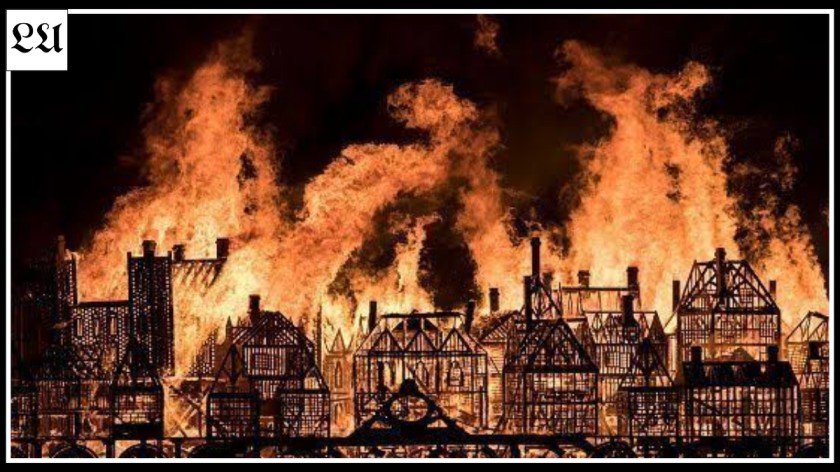
The Great Fire of London was a major disaster that changed the capital forever. It started on 2 September 1666 in a bakery on Pudding Lane and soon spread through the narrow streets. Strong winds and wooden buildings allowed the flames to destroy thousands of homes, shops and churches. Many families lost their belongings and had to find somewhere safe to stay. Although the fire caused terrible damage, it also led to important changes in how London was rebuilt. Today, historical maps, diaries and famous landmarks help us understand the disaster and how Londoners worked together to rebuild their lives.
What Was the Great Fire of London?
The Great Fire of London was a devastating blaze that destroyed a large part of the historic City of London in September 1666. At that time, many buildings stood close together and used timber, thatch and other materials that caught fire easily. Narrow streets made it difficult for people to escape and for workers to reach burning buildings. These conditions allowed the flames to spread quickly from one neighbourhood to another.
The fire damaged thousands of homes, shops, warehouses and churches. One of the most significant losses was Old St Paul’s Cathedral, a medieval building that had served as an important religious and cultural landmark. The fire also affected the city’s commercial life because London was a major centre for trade, shipping and business. Merchants and workers lost valuable goods, workplaces and sources of income.
The disaster became a turning point in the development of the capital. Rebuilding encouraged the use of safer construction materials and introduced stronger rules for new buildings. The authorities also recognised the need for better ways to manage emergencies. Although London faced years of recovery, the rebuilding process helped shape the streets, landmarks and architectural character that visitors can still explore today.
How Did the Great Fire of London Start?
The fire began at the bakery of Thomas Farriner on Pudding Lane during the early hours of Sunday, 2 September 1666. Farriner supplied baked goods, and a small fire in or near the bakery is generally accepted as the starting point. However, the precise sequence of events remains uncertain because no modern investigation methods were available. Historical inquiries generally concluded that the blaze was accidental rather than the result of a proven conspiracy.
Several conditions helped the flames spread. The summer had been dry, many buildings contained flammable materials, and houses stood close together along narrow streets. Strong winds pushed the fire towards neighbouring properties, allowing it to grow into a much larger disaster. Shops and warehouses also stored goods that could burn quickly, adding to the danger in busy commercial areas.
London had no modern fire brigade, powered fire engines or organised emergency service. Residents and officials relied on buckets, water supplies, hooks, ladders and the demolition of buildings to create gaps between burning and unburned areas. These methods sometimes helped, but delays and confusion made the response less effective. As the fire spread, thousands of people had to leave their homes and seek safety elsewhere.
Timeline and Important Facts
The main events took place over several days, although their consequences lasted for years. On 2 September 1666, flames broke out at Pudding Lane and spread through nearby streets. During 3 and 4 September, the fire moved across large parts of the City of London, destroying houses, businesses and churches. The intense heat and flying embers made it difficult for people to predict which areas would be affected next.
Old St Paul’s Cathedral was destroyed during the blaze, becoming one of the most memorable losses. Authorities and residents tried to stop the flames by pulling down buildings and creating firebreaks. By 5 September, the fire was largely under control, although some accounts describe remaining outbreaks into 6 September. Differences in historical descriptions mean that the final date may vary between educational sources.
Several facts show the scale of the disaster. Historians commonly estimate that around 13,200 houses and approximately 87 parish churches were destroyed. Around 100,000 people lost their homes, while the official death toll remained below ten recorded deaths. These figures are widely used, but the death toll is uncertain because some victims may not have been recorded. The fire also did not end the Great Plague, as plague deaths had already been declining before the blaze.
How Many People Died?
The official death toll was surprisingly low compared with the scale of the destruction. Historical records commonly report fewer than ten recorded deaths, and some educational sources give a figure of six. However, these numbers do not necessarily represent everyone who died during the disaster. Records in seventeenth-century London were limited, and officials could only count victims they knew about or could identify.
Some historians believe that deaths may have gone unrecorded, particularly among poorer residents whose lives were less likely to appear in official documents. Extreme heat could also have destroyed physical evidence, making it difficult to identify victims. For these reasons, researchers cannot provide a completely reliable final number. It is more accurate to explain that the official records list very few deaths while acknowledging that the true toll remains unknown.
The wider human cost was enormous. Thousands of families lost their homes, possessions and livelihoods, and many people had to sleep outdoors or find temporary accommodation beyond the city. Shopkeepers and merchants lost their stock, while workers faced uncertainty about their jobs. When studying the death toll, it is important to distinguish between the small number of officially recorded deaths and the much larger number of people whose lives were disrupted by homelessness and financial loss.
The Story of Samuel Pepys and Ordinary Londoners
The story of the disaster is preserved through eyewitness accounts, especially the diary of Samuel Pepys. Pepys was a naval administrator who recorded events as the flames spread through the capital. His diary describes the growing danger, the movement of people through the streets and the fear caused by the destruction. It remains one of the most valuable sources for understanding how the fire unfolded from an individual perspective.
John Evelyn, a writer and diarist, also documented the destruction and its effect on London. These personal accounts help historians understand the experience of people who lived through the event. They describe crowded streets, desperate attempts to save belongings and the shock of seeing familiar buildings disappear. Such accounts provide details that official reports alone cannot fully capture.
Ordinary Londoners faced difficult choices as the fire approached their homes. Some carried possessions away by cart or boat, while others tried to protect goods that supported their livelihoods. Roads became crowded with families seeking safety, and many people had little time to decide what to take. The experiences of these residents show that the disaster was not only a story of destroyed buildings but also a human tragedy involving fear, loss, resilience and recovery.
Maps, Books and Educational Games
A historical map can help readers understand where the fire began and how far it spread. Maps created after the disaster show the damaged areas and provide clues about the layout of seventeenth-century London. They can help pupils locate Pudding Lane, London Bridge, the River Thames and the site of Old St Paul’s Cathedral. Comparing an old map with a modern one also reveals how the city’s streets and buildings have changed.
Books provide another way to explore the event. Children’s history books often use illustrations, timelines and simple language to explain the causes and consequences. Older readers may prefer historical studies, biographies or collections of eyewitness accounts. Samuel Pepys’s diary is particularly useful for understanding how people experienced the emergency. When choosing a book, readers should look for reliable historical information and clear distinctions between evidence and imagined storytelling.
An educational game can make the subject more engaging for children. Activities may ask players to make decisions about escaping the flames, protecting belongings or rebuilding a damaged neighbourhood. For Year 2 pupils, simple quizzes, picture-based timelines and classroom role-play can help explain the main events without overwhelming them with detail. Teachers and parents can combine these activities with museum and archive resources to encourage children to ask questions and examine historical evidence.
Rebuilding London and Its Lasting Legacy
After the fire, London faced the enormous task of rebuilding thousands of homes, shops and public buildings. Architects, builders and craftsmen worked to restore the damaged city, while officials introduced new rules to reduce the risk of future fires. The rebuilding process gradually changed London’s appearance and improved the safety of many new buildings.
The main changes included:
- Safer building materials: Brick and stone became more widely used instead of timber.
- New building regulations: Rules helped improve the design and construction of buildings.
- Wider streets: Some rebuilding plans aimed to improve movement through busy areas.
- St Paul’s Cathedral: Christopher Wren designed a new cathedral to replace the medieval building destroyed by the fire.
- The Monument: Christopher Wren and Robert Hooke designed this landmark to commemorate the disaster.
- Better fire prevention: The disaster encouraged greater attention to firefighting methods and property protection.
Christopher Wren became one of the best-known figures in London’s recovery. His design for St Paul’s Cathedral helped shape the city’s skyline, and the building was formally completed in 1711. Many other architects and skilled workers also contributed to the rebuilding of homes, churches and commercial areas.
The fire also changed how people thought about protecting property and preventing emergencies. Over time, fire insurance and more organised firefighting services became increasingly important. Today, historic landmarks and surviving records help visitors understand how London recovered from the disaster and how the rebuilding effort influenced the capital’s development.
(FAQs)
What started the Great Fire of London?
The fire began at Thomas Farriner’s bakery on Pudding Lane on 2 September 1666. Strong winds and dry weather helped the flames spread rapidly.
How many people died in the Great Fire of London?
Fewer than ten deaths were officially recorded, although the true number remains uncertain. Many people lost their homes and belongings during the disaster.
Does Pudding Lane still exist?
Yes, Pudding Lane still exists in the City of London, near the Monument. Visitors can explore the historic area where the fire began.
What happened to the baker who started the fire?
Thomas Farriner survived the fire, which was generally considered accidental. There is no reliable evidence that he was punished for deliberately starting it.
How long did the fire burn?
The fire began on 2 September 1666 and was largely under control by 5 September. Some accounts describe remaining outbreaks into 6 September.
Conclusion
The Great Fire of London was a devastating event that changed the city forever. It began at a bakery on Pudding Lane in September 1666 and quickly spread through crowded streets, destroying thousands of homes, churches and businesses. Although fewer than ten deaths were officially recorded, the exact number remains unknown, and thousands of families lost everything they owned. However, Londoners worked hard to rebuild their lives and restore their city. The disaster also led to safer building rules and better fire prevention. Today, historic landmarks and eyewitness stories help keep the memory of this important event alive.