


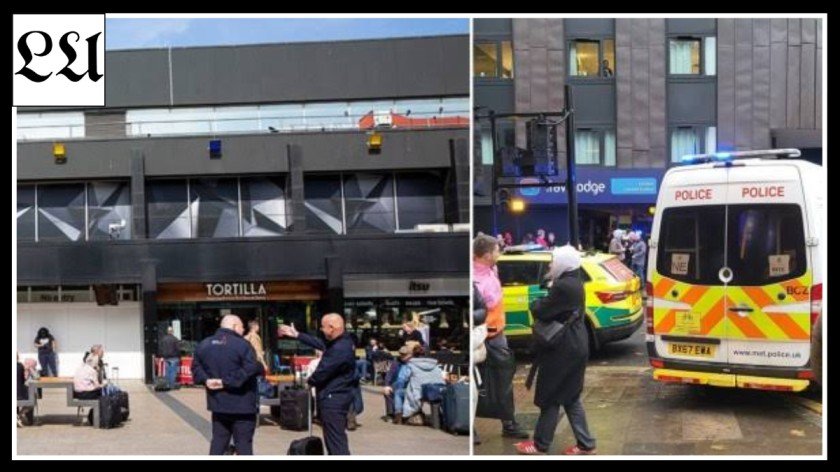
Incidents of people searching for evacuated London Euston usually occur if there are police operations going on inside the station, if there are announcements regarding an emergency situation or due to train delays. As the Euston Station is one of the busiest railway stations in the UK, it is obvious that any sort of temporary closure would affect passengers who use the station regularly or occasionally. The particular incident mentioned here took place on 2 October 2025, whereby the British Transport Police dealt with a suspicious item. Passengers were evacuated as a precautionary measure before everything got back to normal.
What Happened at Euston Station and Why Was It Evacuated?
London Euston was cleared during the afternoon of 2 October 2025 after British Transport Police received information about a suspicious item. Officers attended at approximately 2.45pm while station employees directed passengers away from the main concourse and platforms. People arriving during the incident were prevented from entering until the initial investigation had been completed. Trains approaching the terminal were held, delayed or prevented from boarding passengers. Crowds gathered outside as travellers waited for reliable information about their journeys.
The evacuation was precautionary and did not mean that police had confirmed an attack or dangerous device. A suspicious item may be an unattended suitcase, package, bag or electronic object that cannot be immediately identified. Police must determine who owns it, how long it has been present and whether its location or appearance creates a genuine concern. Officers may examine security footage, speak to witnesses and create a controlled area around the object. These procedures allow the authorities to investigate while keeping passengers away from an uncertain risk.
The reported item was eventually assessed as non-suspicious, and the security cordon was removed. Reports suggested that the main closure lasted for around 20 minutes, although railway disruption continued afterwards. Trains and staff could not instantly return to their original positions when the doors reopened. Platform arrangements also needed to be adjusted to manage delayed arrivals and departures safely. Travellers reading reports about the event should check the date before assuming that the same incident is happening again.
Why Police Treat Security Alerts at Euston Seriously
London Euston contains busy platforms, ticket barriers, shops, waiting areas and passenger walkways. An unidentified object in any of these locations can cause concern because officers may not know what it contains or why it was left there. Police must assess the situation using the information available at that moment instead of waiting for complete evidence of danger. Ignoring a genuine threat could place passengers, railway employees and emergency workers at risk. A precautionary evacuation therefore gives trained officers time to investigate while the public remains at a safer distance.
When an evacuation begins, station staff normally use announcements and direct instructions to guide people towards approved exits. Entrances and ticket barriers may be controlled to prevent additional passengers from entering the building. Trains standing at platforms can be kept closed, while approaching services may be held outside the terminal. Police then establish a restricted area where they can inspect the object, gather evidence and review CCTV recordings. Specialist teams may also attend when an item cannot be safely identified during the initial assessment.
Closing a major station causes inconvenience, but the safety advantages are significant. The response protects passengers, drivers, cleaners, shop workers, contractors and other employees inside the building. It also gives emergency teams enough room to move equipment and investigate without crowds blocking access. Nearby roads and Underground services may become busier as travellers search for alternatives. Despite these difficulties, protecting people must take priority over maintaining the railway timetable during an uncertain security situation.
How the Euston Evacuation Affected Trains and Passengers
The phrase “London Euston evacuated train” reflects the main concern passengers have when the terminal suddenly closes. Euston serves many trains using the West Coast Main Line and connects the capital with Birmingham, Coventry, Manchester, Liverpool, Chester, Milton Keynes, Northampton and Glasgow. A disruption at the station can therefore affect travellers hundreds of miles away from central London. Services depend on specific platforms and carefully planned arrival and departure times. Once those arrangements are interrupted, delays can quickly spread across the wider railway network.
Trains already standing at Euston may be prevented from boarding or releasing passengers during a police operation. Approaching services can be stopped at signals, held outside London or terminated at another station. Some trains may operate after a short delay, while others can be cancelled to reduce congestion. Operators may also change platforms, departure times and stopping patterns when the building reopens. Passengers should check the status of their exact train rather than relying only on a general message about the station.
Even a brief closure can produce disruption lasting several hours because railway timetables depend on precise movements. Several delayed trains cannot enter the terminal at the same time when platforms become available again. A late arrival can affect the train’s next journey because cleaning teams, catering staff and crews receive less preparation time. Drivers and conductors may also finish in the wrong place for their next scheduled service. These connected problems explain why train delays can continue long after the original police investigation has ended.
What Passengers Should Do During and After an Evacuation
Passengers should follow instructions from police and railway employees immediately when an evacuation is announced. They should walk calmly towards the directed exit without running, pushing or moving against the main crowd. Families should remain together and keep children or vulnerable relatives close throughout the process. Travellers should not stop to photograph the scene, argue about a reservation or return for non-essential belongings. Anyone with limited mobility, a disability or a medical condition should request assistance from a staff member as soon as possible.
After leaving the station, people should move away from the main doors and emergency access routes. A large crowd close to the entrance can prevent police vehicles, ambulances and railway workers from reaching the building. Waiting at a safe distance will not normally cause someone to miss a train because boarding cannot restart until platforms officially reopen. Travellers should use this time to check official service information and contact anyone expecting them. Tickets, booking confirmations and screenshots of cancellations should also be retained.
Passengers should take the following practical steps:
- Leave through the exit identified by railway staff.
- Keep children and vulnerable travellers nearby.
- Do not return to a restricted platform or concourse.
- Move away from station doors and emergency vehicles.
- Check the status of the individual train service.
- Ask staff before purchasing another railway ticket.
- Keep evidence of cancellations and significant delays.
- Request accessibility support where it is needed.
- Avoid sharing unconfirmed claims on social media.
- Retain tickets for possible refunds or compensation.
The best alternative route depends on the destination, ticket type and expected duration of the closure. Euston Underground station is served by the Northern and Victoria lines, while Euston Square provides access to the Circle, Metropolitan and Hammersmith & City lines. Local passengers may also be able to use buses or London Overground services. However, another London terminal may not offer a practical replacement for someone travelling to Manchester, Liverpool or Glasgow. Waiting for Euston to reopen can sometimes be quicker than crossing London with luggage and making several changes.
How to Check BBC, Police and Twitter Reports
People often search “what happened at Euston station today BBC” because they want confirmation from a recognised news organisation. However, adding BBC to a Google query does not prove that BBC News has published a report about the latest incident. Search results may show an older article, an unrelated railway story or content from a different publisher. Readers should examine the website name, publication date and latest update time before treating a result as current. An older event should not be presented as a new emergency simply because its headline once included words such as “today” or “breaking”.
The same caution applies to the phrase “why was Euston station evacuated today BBC”. A responsible publisher should not suggest that the BBC confirmed a story unless a genuine BBC report is available. For immediate travel decisions, official railway information may be more useful than a general news article. British Transport Police can explain a police response, while National Rail and individual train operators provide service information. Using both types of source helps passengers understand the incident and its effect on their planned journey.
The search “why was Euston station evacuated today Twitter” shows how quickly reports spread through X and other social platforms. Posts may show crowds, closed entrances and emergency vehicles before an official statement becomes available. However, most people at the scene do not know the complete reason for the response. A photograph of police officers does not prove that an attack, explosion or dangerous device has been confirmed. Travellers should wait for information from the police or another reliable authority before sharing serious claims.
Benefits, Pros and Cons and Was the Evacuation Worth It?
The greatest benefit of a precautionary evacuation is that it moves passengers away from a location where the level of danger remains unknown. Police can inspect the item, examine security footage and speak to witnesses without people walking through the investigation area. Closing the entrances also prevents additional travellers from increasing the size of the crowd. Emergency teams can move equipment more easily when the building has been cleared. These measures may help officers complete their assessment efficiently and restore public access safely.
The main advantages include stronger passenger protection, clearer emergency access and better control of the station environment. Employees working inside shops, offices and trains receive the same protection as passengers. A controlled evacuation can also reduce confusion because everyone receives the same basic instruction to leave. It demonstrates that reports about unidentified objects are taken seriously by the railway and police. This may encourage passengers and employees to report genuine safety concerns instead of ignoring them.
The disadvantages include train delays, cancellations, crowding and uncertainty. Passengers may miss work, medical appointments, events or onward connections, while nearby transport services can become overloaded. Shops and cafés inside the terminal may also lose income during the closure. Tourists, families and disabled passengers may experience additional difficulty when trying to understand alternative routes. Railway disruption can continue for several hours, even when the police assessment is completed quickly.
Frequently Asked Questions About Euston Station
What is happening at Euston station?
The incident involved a suspicious item reported on 2 October 2025.
Police later confirmed it was non-suspicious, and the station reopened.
Why was Euston station evacuated?
Police cleared the station so they could safely inspect an unidentified object.
The evacuation was precautionary and did not confirm a dangerous device.
Why was King’s Cross station evacuated?
King’s Cross has been evacuated for incidents such as smoke reports and fire alarms.
The exact reason depends on the date and circumstances of the event.
Why did they knock down Euston station?
The Victorian station was demolished in the 1960s to build a modern railway terminal.
The redevelopment also removed the historic Great Hall and Euston Arch.
Are there problems at Euston station today?
Train delays and platform changes can occur even when the station remains open.
Passengers should check live railway updates before starting their journey.
Conclusion
The evacuation of London Euston revealed just how fast a security threat could throw a spanner in the works for one of the busiest railway stations in Britain. Despite the fact that the suspicious object turned out to be non-suspicious, the evacuation of the station was a logical and prudent step which would ensure safety for both passengers and employees. In addition, this situation highlighted the reasons behind train delays even after the reopening of the station. People need to follow the instructions of staff members, avoid entrance areas, and consult the news to make changes to the journey plans.